

Lapsang smoked tea, better known as Lapsang Souchong, is a Chinese black tea that leaves no one indifferent. It is instantly recognizable by its smoky aroma, both bold and terribly distinctive.
This unique taste is due to an ancestral drying method. The leaves of the Camellia sinensis plant, variety sinensis, are delicately smoked over a pine or spruce wood fire, which gives them deep, resinous notes reminiscent of a campfire in the great outdoors. Each cup is a true sensory immersion in a centuries-old tradition.
To learn more about the origins and tasting of smoked tea, discover our articles "Smoked tea" and "The art of smoking, diversity & culinary pairings".
What makes Lapsang Souchong so unique?
Imagine for a moment the smell of a crackling wood fire in the misty mountains of Fujian, China. That's precisely the experience every sip of Lapsang Souchong promises. It's not just another black tea; it's a true taste journey that takes us back to where it all began. Its uniqueness comes not only from its taste, but from the history and craftsmanship it carries within.
It's all in the manufacturing process. Unlike other black teas, which are simply oxidized and dried, Lapsang Souchong undergoes an additional step: smoking. This is what makes all the difference.
The soul of the pine in every leaf
The leaves are carefully dried over a pine fire, often fueled by resin-rich roots. It's this method that imbues the leaves with that powerful, almost unforgettable aroma, creating a flavor profile found nowhere else. It's not an added aroma; it's a flavor born from the encounter between leaf and fire.
"Smoking is not a simple addition; it is a dialogue between the tea leaf and the pine wood. The result is a perfect balance between the malty character of black tea and the woody, almost peaty notes of the smoke."
This tea, born from a happy accident several centuries ago, is today an iconic beverage appreciated throughout the world by palates in search of complex and authentic flavors.
This guide is an invitation to explore all its facets:
- Its legendary story: discover how an unforeseen event gave birth to this very special tea.
- Its manufacturing secrets: delve into the steps that give it its unique smoky character.
- The art of tasting it: learn to appreciate all its nuances.
The Accidental Origin and History of Smoked Tea
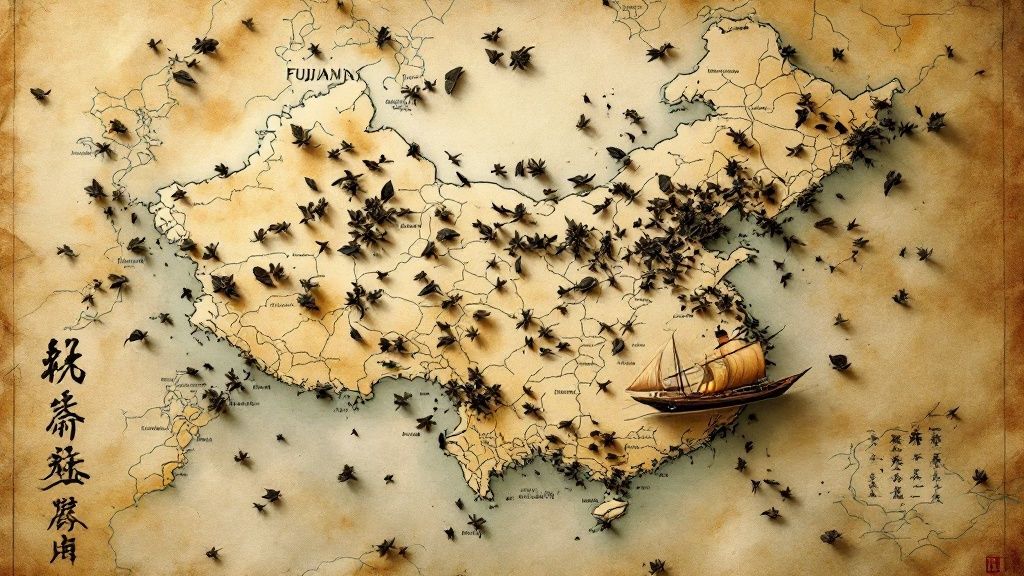
The story of Lapsang Souchong smoked tea is the stuff of legend. It was born out of urgency and chance, deep in the misty Wuyi Mountains of Fujian Province in China in the 17th century. It was in this almost mystical setting that one of the world's most recognizable teas was born, not by design, but by happy accident.
At the time, tea production was a laborious, time-consuming, and meticulous process. But an unexpected event disrupted everything: a passing army commandeered a tea factory, forcing the farmers to stop working.
Pressed for time and fearing the loss of their precious harvest, the producers had to improvise. Their idea was as simple as it was radical: dry the tea leaves quickly by placing them over pine wood fires.
A flavor born of despair
This urgent action completely transformed the destiny of this black tea. Absorbed by the smoke from the wood and pine needles, the leaves developed a powerful, woody aroma that was absolutely unique. What could have been a disaster turned into a formidable innovation.
This smoking method, discovered by chance during the Qing Dynasty, not only saved the harvest, but also gave rise to a flavor that quickly found its fans. Lapsang Souchong was born.
"Instead of ruining the tea, the pine smoke infused the leaves with a deep aromatic complexity. This event perfectly illustrates how constraint can often become the engine of creativity."
The result was a drink with a strong character, with notes of wood fire, resin, and sometimes even a hint of leather or whiskey. Such a distinctive profile quickly attracted attention far beyond the Wuyi Mountains.

Lapsang Souchong's Journey to Europe
In the 17th century, maritime trade with Asia was in full swing. Dutch merchants were among the first Europeans to come across this special smoked tea and decide to import it to the Old Continent. Its strong flavor set it apart from other Chinese and Indian teas known at the time.
This unique tea quickly won over the European aristocracy and intellectual circles, always keen on exotic novelties. It became a symbol of sophistication for those with daring tastes.
Some notable figures particularly appreciated it, such as Winston Churchill, the famous British Prime Minister was a great fan of Lapsang Souchong, which he appreciated for its robust character.
Today, Lapsang Souchong, like many other teas, is a living testament to history. Each cup tells the story of an ingenious solution, the first exchanges between East and West, and the evolution of global trade. A legacy that continues to captivate tea lovers.
The secrets of making Lapsang Souchong
How can simple tea leaves capture the soul of a wood fire? The unique character of Lapsang Souchong smoked tea owes absolutely nothing to chance. It is the result of artisanal know-how, each step mastered to transform a tea leaf into an unforgettable aromatic experience.
The journey begins with careful picking, but it's just after that the magic really begins. The big secret, of course, is the smoking.
The traditional pine fire method
Traditionally, smoking Lapsang Souchong is a ritual. Once wilted, the leaves are delicately placed in large bamboo baskets. These baskets are then traditionally hung over wood fires. Today, the method has evolved to limit direct exposure to smoke.
"The choice of wood is absolutely fundamental. Tradition dictates that we use pine or spruce roots, as they are particularly rich in resin. It is this resin which, when burned, releases a dense and fragrant smoke that coats the leaves."
This process takes place in multi-story wooden buildings, the Qing Lou . Heat and smoke rise from the ground floor, where the fire is kept, slowly passing through the openwork floors where the baskets rest. It is a subtle balancing act, perfected by generations of tea masters.
- Withering and oxidation: first, the leaves are withered to make them more flexible. They are then rolled to break their cells and initiate oxidation.
- First drying (and smoking): they then undergo a first drying, receiving a first bath of smoke which begins to fix the aromas.
- Final rolling and intense smoking: after a final rolling, the leaves move on to final drying. This is where they are exposed to pine smoke for a longer period of time to develop the full complexity of their aromatic profile.

The influence of techniques on taste
While the traditional method remains the benchmark, more modern approaches have emerged to meet growing demand. These techniques, often faster, may use other types of wood or more controlled smoking systems.
But be careful, every detail counts. Light smoking produces a tea with more subtle woody notes, allowing floral and fruity aromas to express themselves. Conversely, intense and long smoking with very resinous pine roots will produce this classic Lapsang Souchong, powerful and bold, with its notes of campfire, leather and dried longan. It is this mastery of the process that makes all the difference and defines an exceptional smoked Lapsang tea.

Discovering a unique aromatic profile and perfect pairings
To dive into a Lapsang Souchong is to indulge in a sensory adventure: its liquor, a deep amber color, is the first promise of the richness that awaits you. If its powerful smoky note is its signature, it is in reality only the gateway to a more complex and nuanced aromatic universe.
Take the time to concentrate, and you'll discover subtle aromas dancing just beyond that curtain of smoke. Notes of pine resin evoke the forests of the Wuyi Mountains, while hints of dried longan bring an unexpected fruity sweetness. Some palates even detect nuances of cocoa, aged leather, or peaty whisky.
Decoding the aromatic palette
The profile of Lapsang Souchong can vary enormously depending on the intensity of smoking and the quality of the tea leaves. It is a tea that reveals itself differently with each infusion, never ceasing to surprise.
"What makes this tea so fascinating is its ability to be both powerful and subtle. The smoke doesn't mask the other aromas; it frames them, creating a depth that few other teas can offer."
Comparison of the aromatic profile of certain black teas
| Characteristic | Lapsang Souchong | Darjeeling | Assam | Ceylon |
|---|---|---|---|---|
| Main profile | Smoky, woody, resinous | Floral, muscat, delicate | Malty, full-bodied, robust | Lively, citrusy, spicy |
| Body | Full and rich | Light to medium | Full-bodied and powerful | Medium and lively |
| Astringency | Low to moderate | Moderate to high | High | Moderate |
| Secondary aromas | Dried longan, cocoa, leather | Peach, apricot | Honey, spices | Notes of chocolate, citrus |
The benefits of smoked tea
Behind its strong character, Lapsang Souchong smoked tea hides the treasures of the Camellia sinensis plant. Like all black teas, it is a mine of antioxidants. It notably contains theoflavins and thearubigins, polyphenols that are formed during the oxidation of the leaves. These compounds are true allies in neutralizing free radicals, thus participating in the protection of our cells against oxidative stress, a recognized factor in premature aging.
Is smoking really safe?
This is THE question that comes up again and again: is this famous smoking process good for your health? The question is legitimate, because combustion can generate undesirable compounds.
Today, things have changed. Producers of quality teas follow strict protocols. Pine or spruce wood is carefully selected and then burned under controlled conditions to prevent the formation of harmful substances. Smoke is precisely managed. International food safety standards guarantee a completely safe end product, making it difficult to find Lapsang Souchong these days, especially if it's organic.
"The idea that smoked tea is inherently dangerous is a myth that has a long life. In reality, a quality Lapsang Souchong is as safe as a good peaty Scotch whisky or a hand-smoked cheese, the production of which is also strictly regulated."

The art of preparing Lapsang Souchong, a ritual of one's own
Preparing a Lapsang Souchong is a bit like a ritual. A simple ritual, but crucial to bringing out all its complexity. Far from being a complicated science, brewing this smoky tea is above all an invitation to play with its intensity to achieve exactly what you like.
Water temperature: to avoid bringing out a bitterness that would mask its more subtle notes, aim for just below the boiling point, around 95°C. Water that is too hot would "burn" the leaves, while water that is not hot enough would struggle to extract all the richness of its woody flavors.
Infusion time: it is with the infusion time that you will be able to sculpt your experience; it is this which will decide the strength of the smoky character in your cup.
- For a softer touch: let it steep for 3 minutes, you will obtain a lighter profile, where the notes of dried longan and pine resin will have room to fully express themselves.
- For a strong character: infuse for up to 5 minutes, and you'll experience an intense, deep smoky flavor reminiscent of a good campfire.
For those curious to explore further, the traditional Chinese method of Gong Fu Cha is a fascinating avenue. This ritual involves using more leaves in a small teapot for multiple, very short infusions (just a few seconds). With each infusion, the tea reveals a new facet of its aromas, moving from intense smokiness to more fruity and mineral notes.
How to keep your leaves looking their best?
To ensure each cup is as good as the first, proper storage is essential. Lapsang Souchong leaves do not like air, light, or humidity. Simply store them in an airtight, opaque container, away from heat and strong odors. If possible, keep them away from your other teas to avoid polluting them.
Any questions?
To complete the loop of our journey to the heart of Lapsang Souchong, let's answer a few questions.
Is Lapsang Souchong high in theine?
Yes, like any good black tea, Lapsang Souchong contains a significant dose of caffeine. It's generally a little less robust than a full-bodied Assam tea, but it has enough to give you a gentle, long-lasting boost. It's the perfect companion for starting the day on the right foot or staying focused during a workday.
Can we add milk or sugar?
Of course! While purists will tell you to enjoy it neat to capture all its nuances, don't hesitate to experiment. A splash of milk softens its smoky power, creating an incredibly comforting drink, a bit like a "Smoky Earl Grey." A touch of sugar or honey will bring out its more subtle notes of dried fruit.
"Lapsang Souchong is a bold tea; it's not afraid of blends. The key is to respect its smoky soul while adjusting it to your taste."
Is this an easy tea to find?
You don't come across it on every street corner, that's for sure. Its consumption remains a niche market for passionate connoisseurs. Since the new regulations, many retailers have stopped selling it because finding high-quality Lapsang Souchong is more difficult. We at Tea Tribes are proud to be able to offer you an exceptional one.
What to eat it with?
Its bold character calls for flavors that deliver. It's an exceptional dining partner for intense dishes. Here are some ideas to surprise your taste buds:
- Savory side: it works wonders with game, smoked meats, salmon or strong cheeses like Roquefort.
- For a sweet touch: dare to pair it with an intense dark chocolate dessert or a dark fruit tart (blackberry, blackcurrant, etc.).
- And in the kitchen? its infused leaves can be used to flavor broth or fish, a marinade for meat, or even to poach eggs to give them a subtle smoky note.
At Tea Tribes & Co, we believe every cup of tea is a journey. We explore the world in search of ancient rituals and hidden gems to share with you. Lapsang Souchong embodies this spirit: a drink born from a powerful story, offering an unforgettable sensory experience.
Explore our collections and follow the trends of tea at https://teatribesandco.com