

Imagine for a moment the smell of a campfire gently crackling in the evening, under a star-filled sky. It is exactly this atmosphere, this woody and comforting essence, that smoked tea manages to capture in a cup. It is a true sensory experience. The most famous of these is undoubtedly the legendary Lapsang Souchong, a Chinese black tea that owes its powerful character to an ancient drying process, just above a pine wood fire.
Dive into the world of smoked tea
Smoked tea, or thé fumé as our French-speaking friends say, is an invitation to travel. A journey where the tea leaf, from the Camellia sinensis plant, meets the raw power of fire.
This method is said to have originated by chance in the misty mountains of Fujian, China. To speed up the drying of the leaves and fill an urgent order, producers apparently came up with the idea of placing them over a pine fire. What began as a makeshift solution became an art, transforming an ordinary tea into a drink of unforgettable character, now consumed from Tibet to Europe.
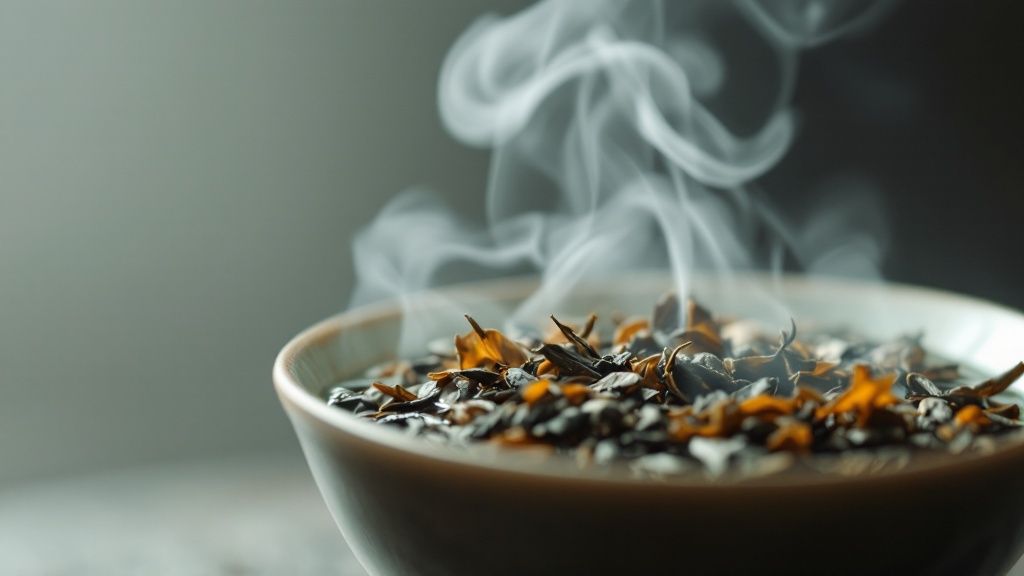
Today, this tradition has spread far beyond China's borders. Other regions have adopted the technique, giving rise to a fascinating palette of flavors. Each culture adds its own touch, whether using longan wood in Taiwan or cedar wood in India, creating smoky teas that tell a story, that of a place and its rituals.
A world of practices and flavors
Far from uniform, the world of smoked tea is surprisingly rich. The secret? The type of wood used for smoking, a true aromatic signature. Each plant gives the leaves a unique imprint.
- Pine and spruce: these resinous woods are the historical signature of Chinese Lapsang Souchong. They give it those intense, peaty notes, reminiscent of Scotch whisky, that enthusiasts adore.
- Longan wood: highly prized in Taiwan, this wood from a fruit tree offers a milder experience. Its aromas are delicate, almost fruity and honeyed.
- More unexpected woods, such as cedar, maple or even apple, are now being explored by gardens in India or Nepal, opening up entirely new taste horizons.
"The magic of smoked tea is really this subtle balance. On one hand, the quality of the tea leaf itself, and on the other, the imprint left by the fire."
Smoked tea is also a choice ingredient that inspires chefs and mixologists. In Tibet, for example, smoked tea is sometimes consumed with yak butter and salt, a nourishing drink suited to the harsh climate. In the West, it is paired with savory dishes, such as smoked salmon or blue cheeses.

When we talk about smoked tea, one name immediately comes to mind: Lapsang Souchong. More than just a tea, it's a true legend in a cup, whose story takes us to the misty Wuyi Mountains, in the heart of China's Fujian province.
This terroir, the cradle of exceptional teas, saw the birth of this tea with such a unique character. And as is often the case with great discoveries, its creation was the result of a happy accident, a twist of fate brought about by the chaos of history.
 Smoked Lapsang Souchong ORGANIC
A birth in fire and smoke
The most popular legend takes us back to the Qing Dynasty. Imagine the scene: soldiers in the middle of a campaign commandeer a tea factory to set up camp. The drying of the freshly picked leaves is abruptly interrupted.
To avoid wasting their precious harvest, the producers, pressed for time, came up with a bold idea. They lit large pine fires to speed up the drying process and placed the tea leaves right on top. This somewhat desperate gesture gave rise to a completely new, powerful, and resinous aroma.
Against all odds, this smoky-tasting tea didn't put off merchants, especially the Dutch, who exported it to Europe. On the contrary, it seduced them! Demand exploded. What had been an emergency solution had become a manufacturing method in its own right: secret of Lapsang Souchong.
From legend to reality
While the myth is delicious, historical reality confirms that the Wuyi region is indeed the birthplace of this smoked tea. The know-how has been passed down from generation to generation, with each tea master perfecting the technique to find the perfect balance.
"The true art of Lapsang Souchong is the mastery of fire. It's not about burning the leaves, but about delicately imbuing them with the soul of the wood. We seek a symphony of aromas, where the tea and the smoke interact without one ever dominating the other."
This ancestral know-how is a subtle dance between the oxidation of the leaves and their exposure to pine or spruce wood smoke. This is where the characteristic notes of Lapsang Souchong come from: resinous wood, smoked bacon, sometimes even a touch of leather. A complexity that fascinates connoisseurs.
A legacy facing modern challenges
This centuries-old tradition has recently had to confront a very contemporary reality: European regulations. The smoking process can generate compounds closely monitored by health authorities (called PAHs).
A debate has therefore taken place around the compliance of this tea. It should be noted that Lapsang Souchong has never been banned, but the legislation on PAHs has become stricter, thereby eliminating some of the existing products on the market. Faced with this new situation, producers have demonstrated an incredible capacity for adaptation. They have revisited their methods, reducing the direct exposure of the leaves to smoke and better controlling temperatures.
The result: a safe product that meets the strictest standards, like the Smoked Lapsang Souchong that we offer at Tea Tribes.
 Organic black tea smoked with pine wood. PAH-free.
The Lapsang Souchong we enjoy today is the fruit of all this history, a blend of legend, know-how and innovation.
The art of preparing and tasting smoked tea
Revealing the full complexity of a smoked tea is an art, but one that's within everyone's reach. Contrary to popular belief, its preparation doesn't require any sophisticated equipment. Just a little attention and adherence to a few key principles.
The adventure begins long before the hot water touches the leaves. Take a moment to observe and smell your tea. Its dark, often long and twisted leaves already carry the promise of a unique sensory journey. This first contact is essential for fully absorbing the character of the beverage.
The secrets of a successful infusion
To release the woody aromas without falling into bitterness, three elements are your best allies: the water temperature, the dosage of leaves and the infusion time.
Aim for just-simmering water, around 95°C. If you don't have a temperature-controlled kettle, simply let the water stand for a minute after boiling.
Generally, use 2 to 3 grams of tea (one teaspoon) for 200 ml of water. Feel free to adjust this rule according to your taste: a little more for a full-bodied flavor, a little less for a first approach.
When it comes to infusion time, precision is key. A short infusion time, between 2 and 4 minutes, depending on your preference. Any longer, and the tannins will take over, masking the richness of the smoky notes.
Questions you may have about smoked tea
The world of smoked tea is as intriguing as it is fascinating. Its strong character often raises questions, and that's perfectly understandable. Let's demystify this unique tea together so you can enjoy it with complete peace of mind.
Is smoked tea dangerous for your health?
This is one of the big questions everyone is asking. The concern comes from compounds called PAHs (polycyclic aromatic hydrocarbons) that can appear during any smoking process (whether it be tea, salmon, sausages, etc.). However, don't panic: regulations are extremely strict on this point.
Quality producers have adapted their methods, for example by using indirect smoking, to strictly adhere to these limits. Furthermore, the diffusion of these substances in hot water remains very low.
We recommend choosing reputable brands to ensure the safety of your smoked tea, such as Tea Tribes & Co.
What is the best smoked tea to start with?
If you are a beginner, I recommend you go for a Lapsang Souchong. Its aromatic profile is subtle and woody. This is the great classic of smoked teas, an excellent gateway to this world.
How to properly store your smoked tea?
Storage is absolutely crucial to preserve its powerful aromas. It is essential to store it in an opaque and perfectly airtight container. Tea Tribes tins are suitable, but for longer storage, we recommend transferring it to a metal tin or a double-lidded washi-lined container, for example. Keep it away from light, moisture, and, above all, other odors.
One key point: never store it next to your other teas! Its smoky aroma is overpowering and could "contaminate" the delicate aromas of your other teas. A cool, dry cupboard will be its ideal home. Keep in mind that the tin used to store it will always retain a smoky scent.
At Tea Tribes & Co, we believe that every cup is an invitation to travel and discover ancestral rituals. Explore our unique collections and find the tea that will reconnect you with what is essential. Visit our website to begin your sensory adventure: https://teatribesandco.com