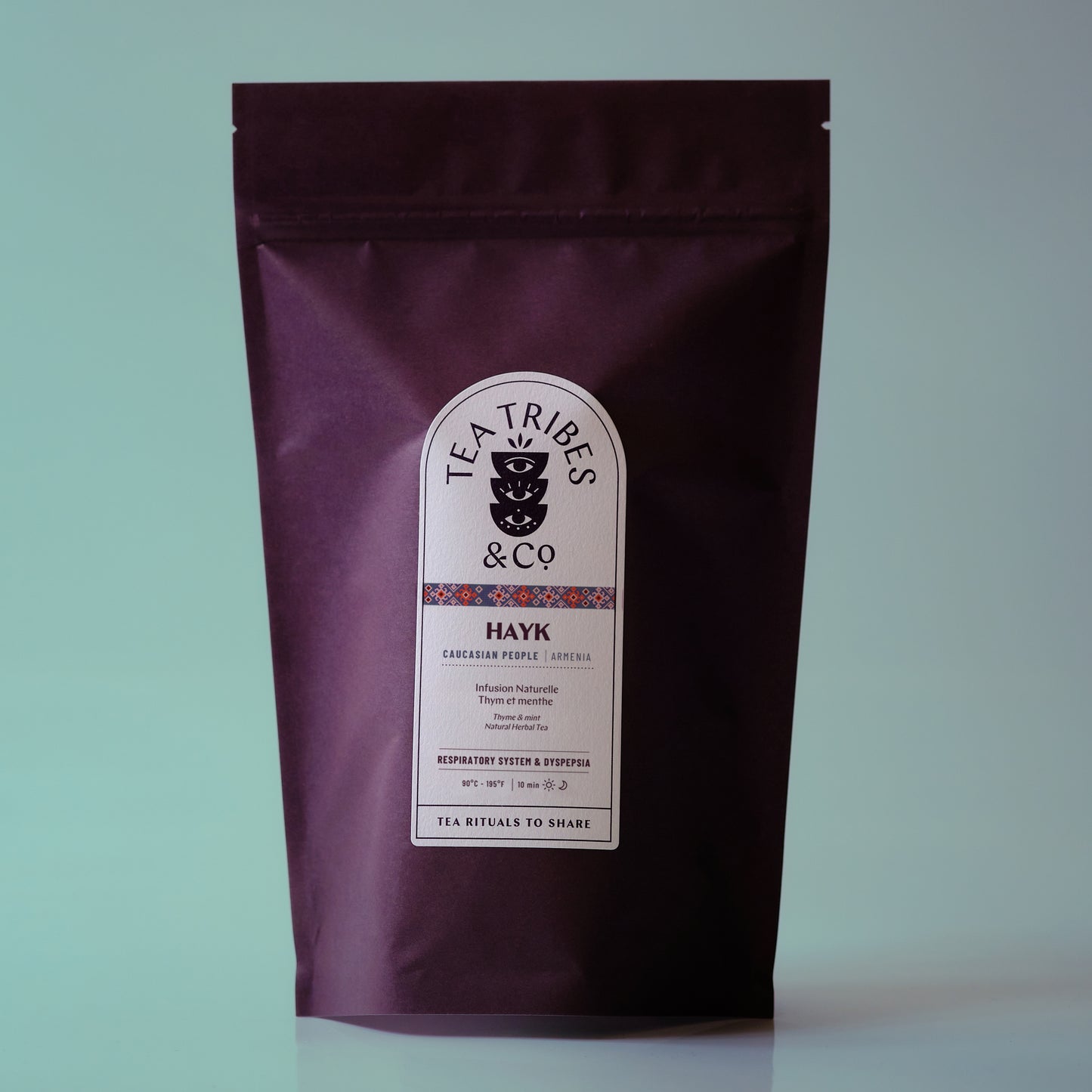
CAUCASIANS / ARMENIA
HAYK
HAYK
RESPIRATORY SYSTEM & DYSPEPSIA
Couldn't load pickup availability
Natural herbal tea of thyme and mint.
- Contributes to the maintenance of upper respiratory tract health.
- May help reduce feelings of bloating
- Supports the immune system
Description & history of the HAYK
Description & history of the HAYK
Armenians refer to themselves as Hays, descendants of the Founding Father, the mythical Hayk, great-great-grandson of Noah. This hero, as majestic as a god and powerful as a giant, led his people to the Caucasus Mountains, where the land of Hayastan was born. Its inhabitants learned to trust the botanical riches of their country to heal themselves. Their thyme and mint infusion is the best example, famous for its delicious aromas and benefits: it is considered both calming (ideal for evening drinks), antispasmodic (limiting both bloating and coughs), and purifying of the respiratory tract (via its antibacterial and anti-inflammatory action, attributed to thymol and rosmarinic acid).
Notes: Herbaceous, lemony and minty
Ingredients, Preparation & Use
Ingredients, Preparation & Use
Ingredients: Thyme (70%), mint (30%). Handcrafted and prepared exclusively in Armenia, in the regions of Aragatsotn, Vayots Dvor, Armavir and Tavush - No added flavoring or sugar.
Preparation: 2 level tablespoons for 1 liter of pure water brought to 90°. Infusion for 10 minutes.
Use: During digestive or respiratory tract inflammations, throughout the day.
Delicious iced too!
A word from the Tea-Triber
A word from the Tea-Triber
A few words from Hermine Nersisyan, biologist, our Tea-Triber on site in Armenia:
"The ingredients of the recipes SERKEVIL and HAYK are grown at an altitude of over 1000 m in the Aragatsotn, Vayots Dzor, Armavir and Tavush regions of Armenia. They are handpicked delicately and sustainably, using traditional tools, taking into account the flowering period and the characteristics of the plants. After undergoing quality controls, the selected plants are carefully aired and washed with water to remove dust, before being dried naturally to best preserve their aromas, their active ingredients and their safety.
These methods of collecting, processing and blending plants are passed down from generation to generation.
The HAYK recipe is said to have soothing, diuretic, biliary, and antispasmodic properties. It can eliminate toxins and intestinal gas. Thyme is traditionally considered to relieve liver and vomiting. It is said to have antiviral, antibacterial, anti-inflammatory, and sedative properties.
According to Martiros de Sebastia, thyme clears the mind and soothes coughs.
A famous Armenian healer, Mkhitar Heratsi, used wild mint, cultivated as a cooling and analgesic remedy, as well as for nausea, vomiting, and diarrhea. He also mentions mint's hypothermic properties.
Amirdovlat of Amasia, a 15th-century Armenian physician and writer, mentions that mint (or "Nana") relieves headaches, eliminates the smell of onion and garlic in the mouth, relieves heart palpitations, cures jaundice, and relieves indigestion.
This recipe is mainly used in Armenia for coughs, sore throats, toothaches, gastrointestinal spasms, diarrhea, nausea, vomiting, gallstones, persistent headaches.
I indicate that the whole thyme plant contains 0.5 to 1% essential oil, composed of thymol, carvacrol, cymol, terpinene, as well as tannins, bitter substances, resin, flavonoids, proteins, oleanolic acid, caffeic acid, as well as chemical elements such as potassium, calcium, magnesium. Mint leaves contain several essential oils, including menthol (41-65%), mentholone and limonene. They also contain flavonoids, carotene, oleic acid.